
Are Your Parking Rates Aligned With How Customers Actually Park
Five questions to help parking operators connect customer behavior with pricing decisions.
A parking rate schedule determines what customers pay. Evaluating whether it works requires a closer look at how long people stay, when spaces fill, and how parking revenue is affected by discounts, validations, and refunds. Those patterns can help operators make pricing decisions that support both the business and the people using the facility.
What a hospital parking sign can tell us
Consider a posted hospital parking schedule: the first 20 minutes are free, followed by $4 for 20 to 30 minutes, $6 for 30 to 60 minutes, and $7 for one to two hours. The rate is $8 for two to 23 hours, with a posted charge of $10 for stays over 23 hours.
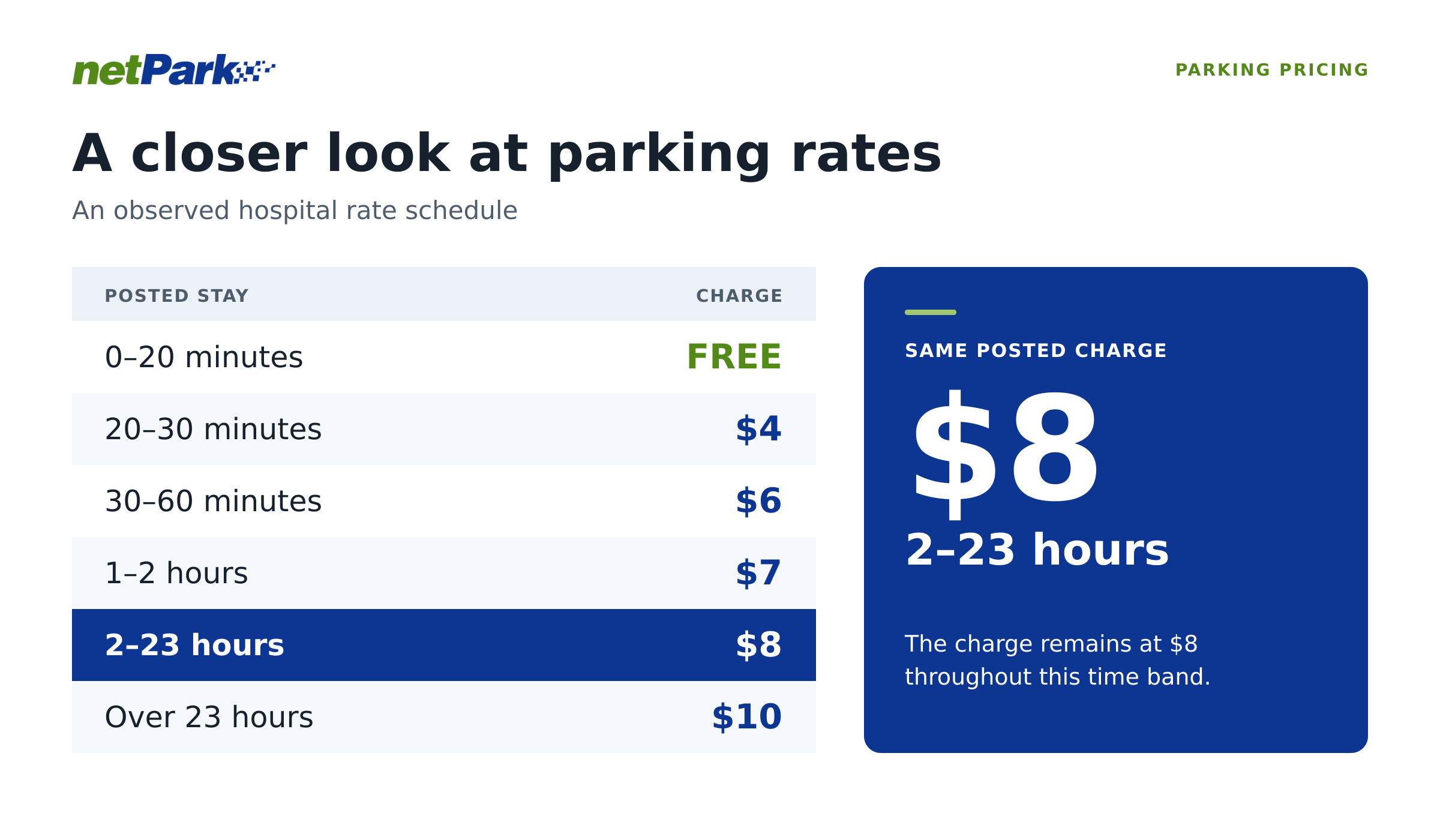
The price rises quickly during the early part of a visit, then remains level across a much longer period. That structure may help serve short visits while keeping longer visits affordable. The sign alone cannot tell us how many customers use each time band, why the operator selected these rates, or whether they deliver the best financial result.
For your facility, the useful question is whether your own rate structure reflects the parking activity you actually see. Start with these five areas.
Understand how long customers stay
Group completed visits into duration bands that match your rate schedule. Review the share of visits in each band, including free and validated stays. An average stay can hide a mix of brief visits and all-day parking, even though those groups place different demands on the facility.
Use physical entry and exit times where available. Confirm whether ticket open and close times reflect those events at your facility. Billed time can differ because of rounding, grace periods, or caps. Separate hourly visitors from permit and contract parkers.
Compare revenue with space use
For each duration band, compare its share of visits with its share of parking revenue and total hours parked. A small number of long stays can use a large share of capacity. That matters most when those stays overlap with periods when other customers cannot find a space.
Total hours parked provide context, but they do not establish peak occupancy. Use occupancy records to identify when capacity is tight before deciding whether a different rate structure could help.
Review what customers actually pay
Review discounts, validations, credits, and refunds alongside the rate rules. A validation may shift the charge to a business or other sponsor. Include that revenue once when assessing the visit; a reduced charge to the parker does not necessarily mean the operator loses the same amount.
Check for expired discounts or inconsistent processes. Use a consistent revenue definition, avoid counting a credit and its related refund twice, and separate parking charges from taxes, additional services, and cash collections. Revenue also differs from profit because operating costs remain.
Match pricing to the purpose of the facility
A hospital visitor may need an affordable extended stay. A retail location may prioritize access for shorter visits. A downtown garage may need to accommodate both daily commuters and occasional customers. Define the outcome your facility needs before changing a rate.
Review grace periods, validations, caps, and signage together. A rate change should be understandable to customers and workable for the team managing the operation. Revenue is one measure of success; availability and the customer experience also matter.
Test a specific change and review the result
Choose one clearly defined change, such as a revised time band, validation rule, or cap. Use recent, representative activity to estimate how it would affect the same visits. Treat that estimate as a scenario: customers may respond differently once prices change.
Set a baseline and a review date. Compare equal-length periods with comparable weekdays and operating hours, noting holidays, events, closures, and other demand changes. Track total parking revenue, visit volume, revenue per visit, peak occupancy, and customer feedback. A higher average payment does not automatically mean higher total revenue.
Use parking software to support the review
netPark brings rate configuration, discounts, validations, and operational reporting into a cloud-based parking management platform. Its Rate Revenue Report shows ticket counts and revenue by rate code. The Daily Summary Report distinguishes ticket open-to-close duration from charged time. Confirm how your location records those timestamps before using them as a measure of physical parking duration.
Use the reports and exports available for your operation to investigate these questions. Comparisons within a rate code, including individual duration bands, may require additional analysis of exported records.
Start your parking rate review
Download the free Parking Rate Review Worksheet to organize your data, compare stay patterns with revenue, and document one change to evaluate. The fillable worksheet includes a duration-band table, a revenue review, and a plan for measuring results.

Complete the form below to access your free worksheet.
Want to see how netPark can support your review? Request a demo focused on rate configuration and reporting, and bring the questions you want your parking data to answer.
Request a netPark demo